Khóa học
IELTS Online
IELTS Online
Giảm đến 18%
Đăng ký ngay
Mục lục [Ẩn]
Phần bài Left or Right luôn là một trong những thử thách khó nhằn của IELTS Reading, yêu cầu thí sinh vừa đọc hiểu nhanh vừa phân tích thông tin chi tiết. Bài viết này tổng hợp đáp án chính xác, phân tích từng đoạn và từ vựng quan trọng, giúp bạn nắm chắc chiến lược làm bài và tiết kiệm thời gian trong phòng thi. Đồng thời, Langmaster cũng chia sẻ mẹo nhận biết chi tiết “left or right” để dễ dàng xử lý các câu hỏi dạng bài IELTS Reading True/ False? Not given.
Reading Passage
An overview of some research into lateralization: the dominance of one side of the body over the other
A. Creatures across the animal kingdom have a preference for one foot, eye or even antenna. The cause of this trait, called lateralisation, is fairly simple: one side of the brain, which generally controls the opposite side of the body, is more dominant than the other when processing certain tasks. This does, on some occasions, let the animal down, such as when a toad fails to escape from a snake approaching from the right, just because it’s right eye is worse at spotting danger than its left. So why would animals evolve a characteristic that seems to endanger them?
B. For many years it was assumed that lateralisation was a uniquely human trait, but this notion rapidly fell apart as researchers started uncovering evidence of lateralisation in all sorts of animals. For example, In the 1970s. Lesley Rogers, now at the University of New England in Australia, was studying memory and learning in chicks. She had been injecting a chemical into chicks’ brains to stop them learning how to spot grains of food among distracting pebbles, and was surprised to observe that the chemical only worked when applied to the left hemisphere of the brain. That strongly suggested that the right side of the chicks brain played little or no role in the learning of such behaviours. Similar evidence appeared in songbirds and rats around same time, and since then, researchers have built up an impressive catalogue of animal lateralisation.
C. In some animals, lateralisation is simply a preference for a single paw or foot, while in others it appears in more general patterns of behaviour. The left side of most vertebrate brains, for example, seems to process and control feeding. Since the left hemisphere processes input from the right side of the body, that means animals as diverse as fish, toads and birds are more likely to attack prey or food items viewed with their right eye. Even humpback whales prefer to use the right side of their jaws to scrape sand eels from the ocean floor.
D. Genetics plays a part in determining lateralisation, but environmental factors have an impact too. Rogers found that a chick’s lateralisation depends on whether it is exposed to light before hatching from its egg – if it is kept in the dark during this period, neither hemisphere becomes dominant. In 2004, Rogers used this observation to test the advantages of brain bias in chicks faced with the challenge of multitasking. She hatched chicks with either strong or weak lateralisation, then presented the two groups with food hidden among small pebbles and the threatening shape of a fake predator flying overhead. As predicted, the birds incubated in the light looked for food mainly with their right eye, while using the other to check out the predator. The weakly-lateralized chicks, meanwhile, had difficulty performing these two activities simultaneously.
E. Similar results probably hold true for many other animals. In 2006, Angelo Bisazza at the University of Padua set out to observe the differences in feeding behaviour between strongly-lateralized and weakly-lateralized fish. He found that strongly-lateralized individuals were able to feed twice as fast as weakly-lateralized ones when there was a threat of a predator looming above them. Assigning different jobs to different brain halves may be especially advantageous for animals such as birds or fish, whose eyes are placed on the sides of their heads. This enables them to process input from each side separately, with different tasks in mind.
F. And what of those animals who favour a specific side for almost all tasks? In 2009, Maria Magat and Culum Brown at Macquarie University in Australia wanted to see if there was general cognitive advantage in lateralisation. To investigate, they turned to parrots, which can be either strongly right- or left-footed, or ambidextrous (without dominance). The parrots were given the intellectually demanding task of pulling a snack on a string up to their beaks, using a coordinated combination of claws and beak. The results showed that the parrots with the strongest foot preferences worked out the puzzle far more quickly than their ambidextrous peers.
G. A further puzzle is why are there always a few exceptions, like left-handed humans, who are wired differently from the majority of the population? Giorgio Vallortigora and Stefano Ghirlanda of Stockholm University seem to have found the answer via mathematical models. These have shown that a group of fish is likely to survive a shark attack with the fewest casualties if the majority turn together in one direction while a very small proportion of the group escape in the direction that the predator is not expecting.
H. This imbalance of lateralisation within populations may also have advantages for individuals. Whereas most co-operative interactions require participants to react similarly, there are some situations – such as aggressive interactions – where it can benefit an individual to launch an attack from an unexpected quarter. Perhaps this can partly explain the existence of left-handers in human societies. It has been suggested that when it comes to hand-to-hand fighting, left-handers may have the advantage over the right-handed majority. Where survival depends on the element of surprise, it may indeed pay to be different.
Questions 27-30
Complete each sentence with the correct ending, A-F, below.
Write the correct letter, A-F, in boxes 27-30 on your answer sheet.
27. In the 1970s, Lesley Rogers discovered that _____________________
28. Angelo Bisazza’s experiments revealed that _____________________
29. Magat and Brown’s studies show that __________________
30. Vallortigara and Ghirlanda’s research findings suggest that _______________
Questions 31-35
Complete the summary below.
Choose ONE WORD ONLY from the passage for each answer.
Write your answers in boxes 31-35 on your answer sheet.
Lesley Rogers’ 2004 Experiment
Lateralisation is determined by both genetic and ______________ influences. Rogers found that chicks whose eggs are given __________________ during the incubation period tend to have a stronger lateralisation. Her 2004 experiment set out to prove that these chicks were better at ________________ than weakly lateralized chicks. As expected, the strongly lateralized birds in the experiment were more able to locate _________________ using their right eye while using their left eye to monitor an imitation _________________ located above them.
Questions 36-40
Reading Passage 3 has eight paragraphs, A-H.
Which paragraph contains the following information?
Write the correct letter, A-H, in boxes 36-40 on your answer sheet.
NB You may use any letter more than once.
36. description of a study which supports another scientist’s findings.
37. the suggestion that a person could gain from having an opposing lateralisation to most of the population.
38. reference to the large amount of knowledge of animal lateralisation that has accumulated.
39. research findings that were among the first to contradict a previous belief.
40. a suggestion that lateralisation would seem to disadvantage animals.
>> Xem thêm: Cách làm Gap Filling IELTS Reading “ẵm trọn” điểm cao
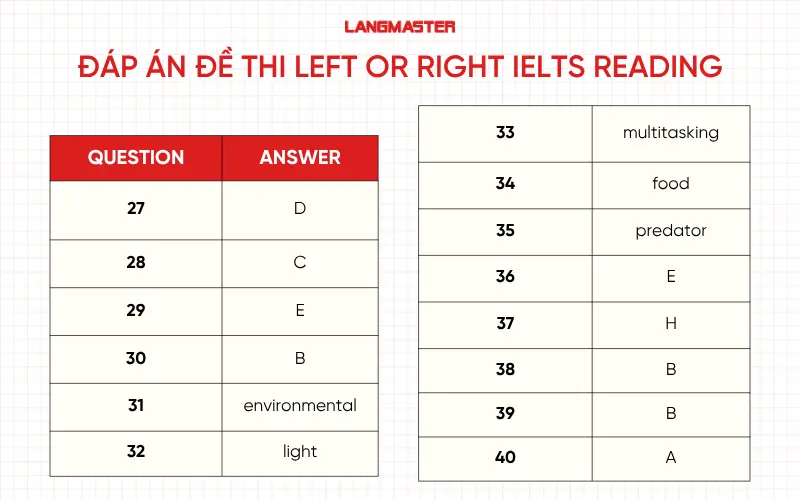
27. Đáp án: D
Giải thích: Trong đoạn B, Lesley Rogers phát hiện rằng khi tiêm chất hóa học vào bán cầu trái não gà con, khả năng học bị ảnh hưởng — điều này chứng tỏ bán cầu não phải ít tham gia, và hiện tượng này không chỉ có ở con người mà cũng có ở động vật khác như chim, chuột → lateralisation tồn tại ở nhiều loài.
→ “... it was assumed that lateralisation was a uniquely human trait, but this notion rapidly fell apart ... Rogers ... found evidence of lateralisation in chicks ... Similar evidence appeared in songbirds and rats ...”
28. Đáp án: C
Giải thích: Trong đoạn E, Bisazza (2006) quan sát cá và phát hiện cá có sự lateralisation mạnh ăn nhanh gấp đôi khi có mối đe dọa, vì mỗi bên não có thể đảm nhận nhiệm vụ khác nhau cùng lúc – ví dụ: một bên xử lý thông tin về kẻ thù, bên kia tập trung vào việc ăn.
→ “Strongly-lateralized individuals were able to feed twice as fast ... when there was a threat ... Assigning different jobs to different brain halves may be especially advantageous ...”
29. Đáp án: E
Giải thích: Trong đoạn F, Magat & Brown (2009) nghiên cứu vẹt và thấy những con có xu hướng sử dụng mạnh một chân (tức lateralisation mạnh) giải câu đố nhanh hơn so với những con “ambidextrous” (không thiên bên nào).
→ “Parrots with the strongest foot preferences worked out the puzzle far more quickly than their ambidextrous peers.”
30. Đáp án: B
Giải thích: Trong đoạn G, hai nhà khoa học này tạo mô hình toán học cho thấy một đàn cá sống sót tốt hơn nếu đa số quay cùng hướng, nhưng một số ít quay khác hướng → điều này giúp nhóm tránh được kẻ săn mồi.
→ “A group of fish is likely to survive ... if the majority turn together in one direction while a very small proportion escape in the direction that the predator is not expecting.”
31. Đáp án: environmental
Từ loại: adjective (tính từ)
Dẫn chứng trong đoạn D: “Genetics plays a part in determining lateralisation, but environmental factors have an impact too.”
Giải thích: Lateralisation (sự chi phối não bộ) bị ảnh hưởng không chỉ bởi gen (genetic) mà còn bởi yếu tố môi trường xung quanh (environmental).
32. Đáp án: light
Từ loại: noun (danh từ)
Dẫn chứng đoạn D: “Rogers found that a chick’s lateralisation depends on whether it is exposed to light before hatching ... if it is kept in the dark, neither hemisphere becomes dominant.”
Giải thích: Trứng gà được chiếu sáng trong quá trình ấp → gà con có lateralisation mạnh hơn.
33. Đáp án: multitasking
Từ loại: noun (danh từ)
Dẫn chứng đoạn D: “In 2004, Rogers used this observation to test the advantages of brain bias in chicks faced with the challenge of multitasking.”
Giải thích: Thí nghiệm 2004 nhằm chứng minh gà có lateralisation mạnh làm tốt hơn khi thực hiện nhiều việc cùng lúc.
34. Đáp án: food
Từ loại: noun
Dẫn chứng (Đoạn D): “As predicted, the birds incubated in the light looked for food mainly with their right eye, while using the other to check out the predator.”
Giải thích: Gà có lateralisation mạnh dùng mắt phải để tìm thức ăn.
35. Đáp án: predator
Từ loại: noun
Dẫn chứng đoạn D: “... while using the other to check out the predator.”
Giải thích: Gà sử dụng mắt trái để quan sát kẻ săn mồi giả bay phía trên.
36. Đáp án: E
Giải thích: Đoạn E nói về nghiên cứu của Angelo Bisazza (2006) với cá — kết quả tương tự với thí nghiệm của Lesley Rogers (2004) ở đoạn D. Cả hai đều cho thấy lateralisation giúp động vật làm hai việc cùng lúc (multitasking).
→ “Similar results probably hold true for many other animals. In 2006, Angelo Bisazza ... found that strongly-lateralized individuals were able to feed twice as fast ...”
Cụm “Similar results” cho thấy đây là một nghiên cứu hỗ trợ phát hiện trước đó của Rogers.
37. Đáp án: H
Giải thích: Đoạn H nói rằng người thuận tay trái có thể có lợi thế khi chiến đấu tay đôi vì họ khác với phần lớn người thuận tay phải.
→ “It has been suggested that ... left-handers may have the advantage over the right-handed majority.”
Con người có thể hưởng lợi khi có lateralisation ngược với số đông.
38. Đáp án: B
Giải thích: Đoạn B mô tả quá trình phát hiện lateralisation ở nhiều loài động vật và nói rõ:
“Since then, researchers have built up an impressive catalogue of animal lateralisation.”
→ Đây là đoạn nhắc đến khối lượng kiến thức lớn đã được tích lũy.
39. Đáp án: B
Giải thích: Cũng trong đoạn B, trước đó người ta tin rằng lateralisation chỉ có ở con người, nhưng nghiên cứu của Lesley Rogers là một trong những phát hiện đầu tiên bác bỏ niềm tin đó.
→ “It was assumed that lateralisation was a uniquely human trait, but this notion rapidly fell apart as researchers started uncovering evidence …”
40. Đáp án: A
Giải thích: Ngay đoạn mở đầu A nói rằng lateralisation đôi khi gây bất lợi cho động vật — ví dụ con cóc không chạy thoát khỏi rắn do mắt phải yếu hơn.
→ “This does, on some occasions, let the animal down ... So why would animals evolve a characteristic that seems to endanger them?”
→ Lateralisation có vẻ khiến động vật gặp bất lợi.
>> Xem thêm:
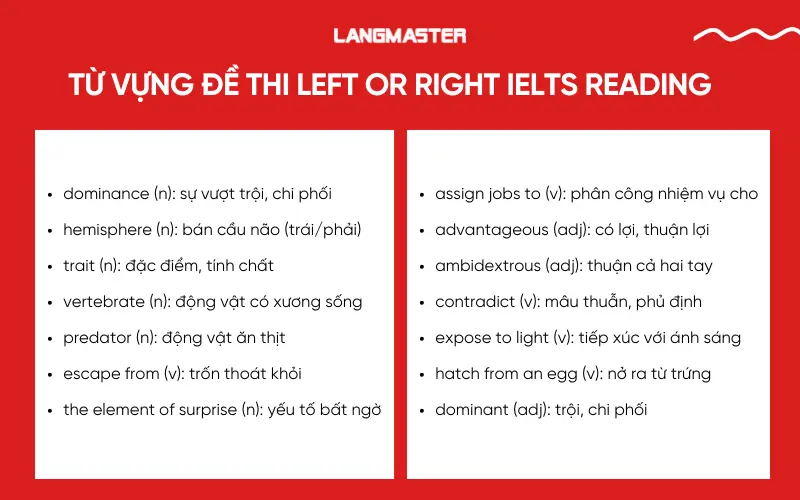
Để hiểu sâu và ghi nhớ kiến thức từ bài “An overview of some research into lateralisation: the dominance of one side of the body over the other”, việc nắm vững từ vựng IELTS Reading là vô cùng quan trọng.
Phần bài Left or Right trong IELTS Reading không chỉ thử thách khả năng đọc hiểu mà còn đòi hỏi bạn phải biết cách xác định từ khóa, suy luận logic và nắm bắt chi tiết khoa học phức tạp. Đây là dạng bài điển hình giúp thí sinh rèn luyện tư duy phân tích – kỹ năng then chốt để đạt band 7.0+ Reading. Tuy nhiên, nếu chỉ luyện đề đơn lẻ mà không có định hướng hoặc chiến lược làm bài rõ ràng, bạn sẽ rất dễ rơi vào “bẫy” của đề thi.
Để chinh phục phần Reading hiệu quả hơn, bạn cần một lộ trình học có hệ thống, kết hợp giữa rèn kỹ năng đọc học thuật, mở rộng vốn từ vựng chuyên sâu và được giáo viên hướng dẫn chi tiết từng dạng câu hỏi. Đây chính là điểm mạnh của khóa học IELTS online tại Langmaster – nơi giúp hàng nghìn học viên tự tin vượt qua mức điểm mục tiêu.

Tại sao nên chọn Langmaster?
Với sự đồng hành của Langmaster, việc “giải mã” Left or Right IELTS Reading passage hay bất kỳ dạng bài khó nào khác sẽ trở nên dễ dàng và thú vị hơn bao giờ hết.





Các dạng bài phổ biến và tiêu chí chấm điểm IELTS Reading chi tiết nhất: Multiple Choice, Matching Information, Matching Headings,... và hướng dẫn chiến lược làm bài hiệu quả

Những sai lầm khi luyện IELTS Reading bao gồm: dịch từng từ, đọc hết cả bài, không đọc câu hỏi trước, không quản lý thời gian, không nắm vững kỹ năng paraphrase, viết sai chính tả
![Giải đề IELTS Reading: A brief history of humans and food [full answers]](https://langmaster.edu.vn/storage/images/2025/09/20/a-brief-history-of-humans-and-food-ielts-reading-answers.webp)
Giải đề thi IELTS Reading “A brief history of humans and food” kèm full đề thi thật, câu hỏi, đáp án, giải thích chi tiết, và từ vựng cần lưu ý khi làm bài.

Tổng hợp IELTS Reading tips hay nhất giúp bạn đọc nhanh, nắm ý chính và xử lý thông tin chính xác, tự tin đạt điểm cao trong kỳ thi IELTS.
![Giải đề IELTS Reading: The importance of law [Full answers]](https://langmaster.edu.vn/storage/images/2025/09/22/55.webp)
Giải đề IELTS Reading “The importance of law” kèm đáp án chi tiết, từ vựng quan trọng và bí quyết luyện thi hiệu quả để nâng cao band điểm.





Hơn 16 năm kinh nghiệm, đào tạo thành công 800.000+ học viên
Phương pháp giảng dạy hiện đại, học viên tiến bộ rõ rệt
Lộ trình học chuẩn quốc tế, phù hợp với nhu cầu thực tiễn
Giáo viên đạt chuẩn Quốc tế với chất lượng top đầu thị trường, giàu kinh nghiệm
Học online linh hoạt, cam kết đầu ra bằng văn bản